Orchestrating the Payment Activation Funnel
Imagine an e-commerce platform where half of the loyal users are unable to add their credit cards.
This project was about repairing that critical 'payment bridge' to ensure business continuity for thousands of companies.
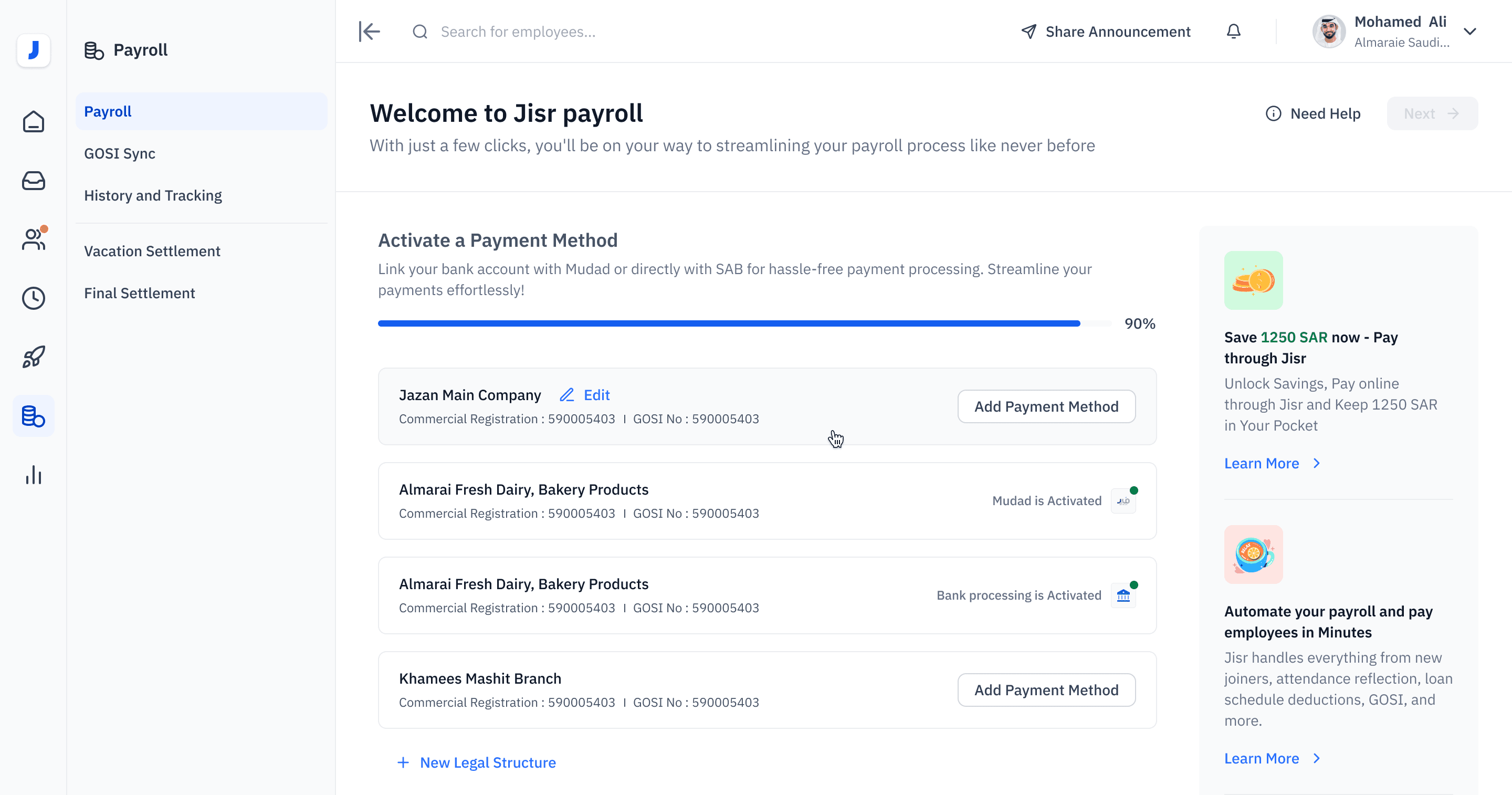
Within Jisr ecosystem, Mudad integration serves as the ultimate retention engine; users who successfully activate it show nearly 100% retention.
As Product Design Manager, I led the strategic overhaul of a fractured activation process where 53% of users were dropping off before ever reaching that value.
56%
Increase in activation rate
51%
13%
CSAT improvement
Jisr HR
B2B SaaS HR Tech
Product Design Manager
1 Product Designer
1 Product Manager
2 Engineers
Strategic Context
As the leading HRMS in Saudi Arabia, Jisr’s position is built on trust, regulatory depth, and local compliance. In this market, HR software is not merely an organizational tool, it is a legal gateway to government-mandated systems.
Mudad, Saudi Arabia’s semi-governmental wage protection and payroll infrastructure, sits at the center of that ecosystem. For our customers, integrating with Mudad is not a “nice-to-have” feature; it is a legal prerequisite for paying employees and operating compliantly. As a result, successful Mudad activation represents Jisr’s single strongest retention lever.
The Problem
Despite Mudad being mandatory for payroll compliance, the activation flow optimized for completion speed rather than correctness.
Users who appeared “successfully onboarded” often failed later—during authorization, verification, or first payment—creating silent churn, broken trust, and escalating operational costs. What looked like progress in onboarding metrics was, in reality, a failure in the most critical moment of the payment journey.
A Strategic Conflict
The Organizational Hurdle
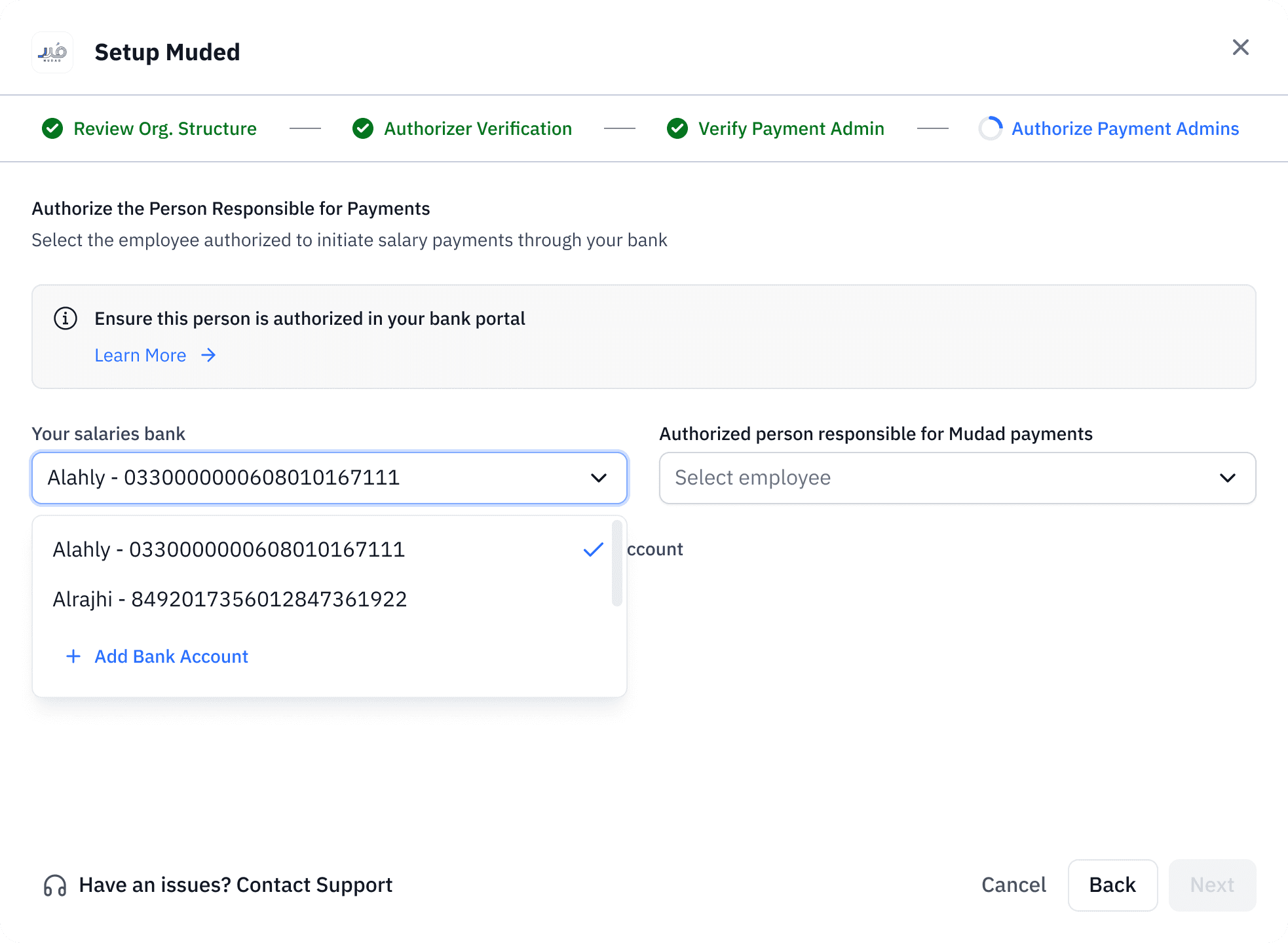
The "Dummy Data" Trap: To hit onboarding targets, internal enablement team were instructing users to skip legal structure data with "dummy numbers".
This prioritized speed over accuracy, leading to catastrophic failures in downstream payment processing.
The Managerial Decision
I halted the "speed-at-all-costs" approach. Steering the team to prioritize Data Integrity as a non-negotiable foundation.
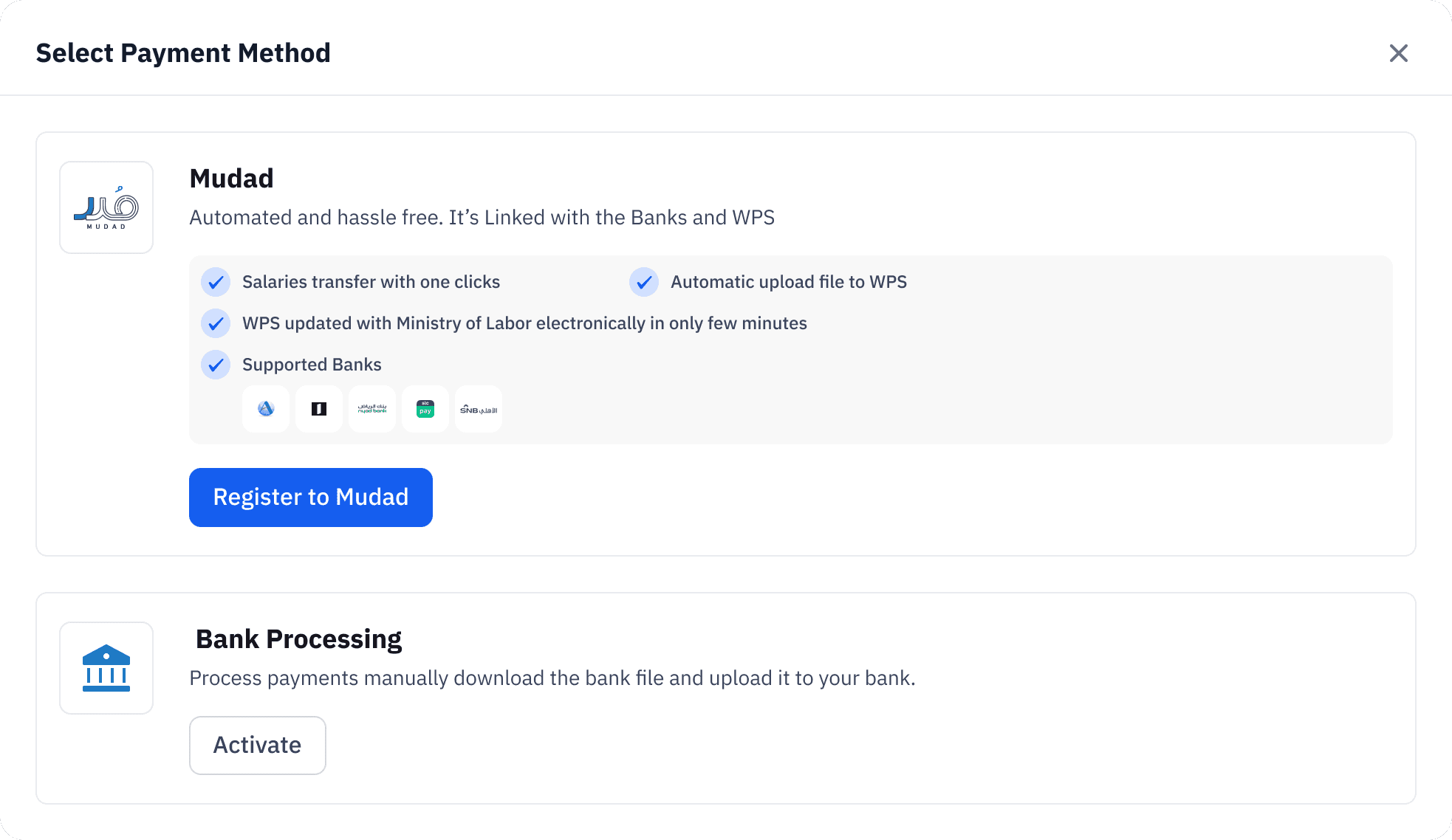
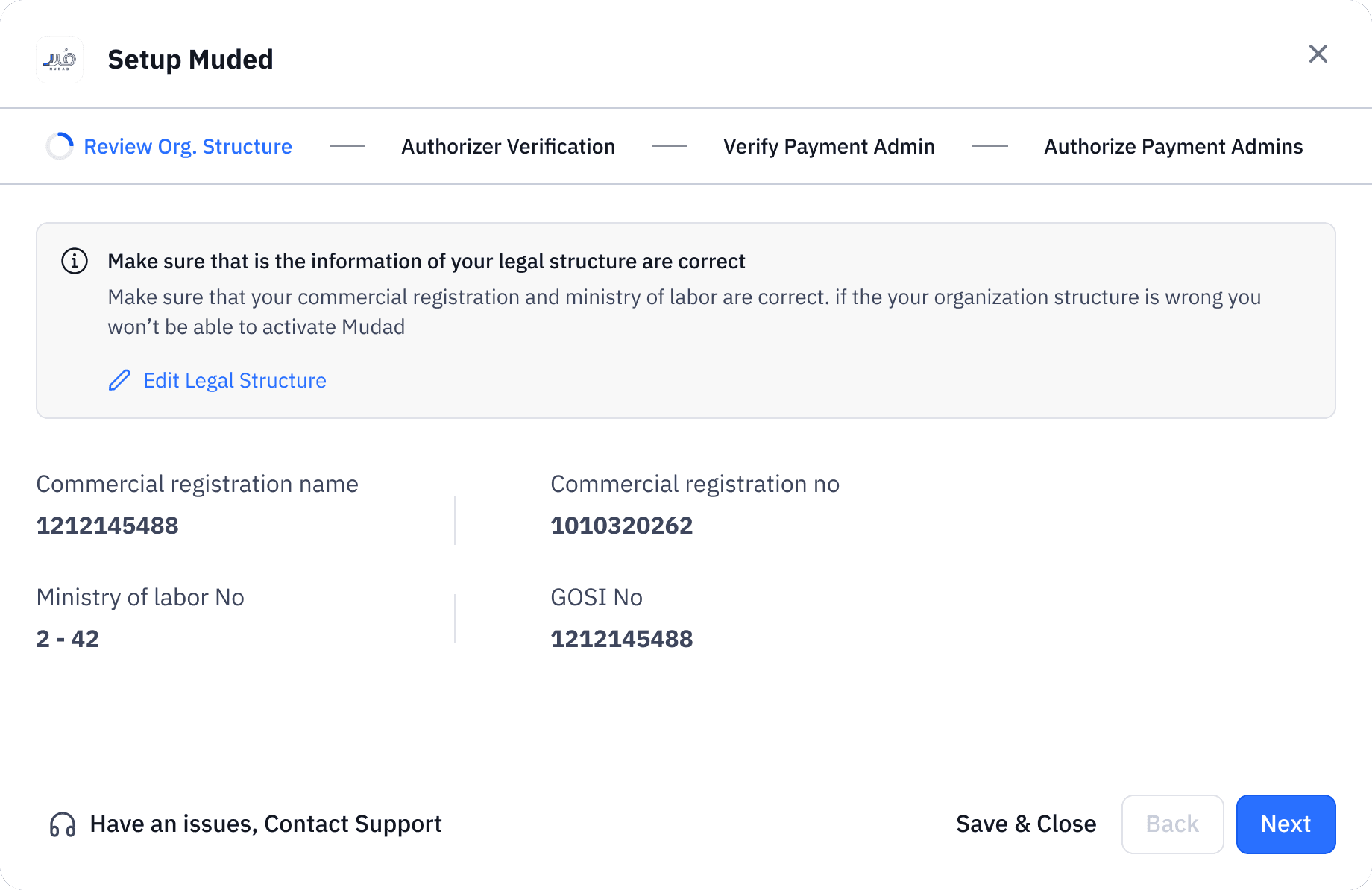
We moved legal structure verification to the front of the funnel, ensuring that every user who proceeded was actually capable of completing a payment.
Decision Frameworks
Integrity > Velocity
I halted the "speed-at-all-costs" mentality that encouraged incorrect legal data. Steering the team to prioritize Data Integrity as a non-negotiable foundation, moving verification to the front of the funnel to ensure success later in the journey.
The "Off-Ramp" Strategy
We debated a key tradeoff: Automation vs. Support. Recognizing we couldn't automate every government edge case, I championed a strategy to increase operational load in exchange for retention. We accepted a 22% rise in support tickets as a strategic investment to capture high-value users who would otherwise churn.
Cultural Pivot: From Tool to Mentor
Shadowing revealed that Saudi Arabian users value "mentorship" over solitary troubleshooting. I directed the team to pivot our UI voice from "system status" to "advisory," implementing "Pro-tips" that positioned the software as a consultant.
Conclusion
I think true leadership isn't about removing all the friction. It's about placing the friction where it adds value. We accepted a 22% increase in support tickets in the short term to buy a lifetime of trust and data integrity. That's a trade I'll make every time.